• Tentang Unud
  • E-Library
  • IMISSU
  • LPPM
  • OASE
  • en EN
    • en INA
    • en EN
PHARMACY STUDY PROGRAM
FACULTY OF MATHEMATICS AND SCIENCE
  • Home
  • Profile
    • History
    • Vision Mission and Goal
    • Organizational Structure
    • Facilities
      • Digital Library
      • Laboratorium Bahasa
      • Career Development Center
      • business incubator
      • Integrated Research Laboratory
    • Student Profile
    • Cooperation
    • Welcome Message from the Study Program Coordinator
    • Acceditation
    • Video Profile
    • Lecturers
    • Educational Staff
  • Academic
    • Final Exam
      • Final Exam Guideline
      • Presentasi TA 2020
      • Presentasi TA 2021
      • Topic Registration
      • Final Exam I Registration
      • Final Exam II Registration
      • Unggah berkas pendaftaran TA 2
    • Curriculum
    • Academic Calendar
    • Jurnal Farmasi Udayana
  • Survey
    • Service Satisfaction Questionnaire
  • Student Affairs
    • Student Development and Welfare
    • Tracer Studi
    • Alumni
  • Research and Community Service
    • Research Pharmacy Research Roadmap
    • Workshop dan Seminar Nasional Farmasi (WSNF)
  • Home
  • Graduate Profile

Graduate Profile

Bachelor of Pharmacy Study Program

Graduate Profile and Program Learning Outcomes

Graduate profiles and competencies developed through the educational process of the Bachelor of Pharmacy Study Program, Faculty of Mathematics and Natural Sciences, Udayana University.

Graduate Profile

Bachelor of Pharmacy graduates are expected to demonstrate excellence, independence, and cultural awareness as:

1

Prospective Pharmacist Professional and Master's Students

Bachelor of Pharmacy graduates who possess the qualifications to continue their studies in a Pharmacist Professional Program and/or a Master's Program.

2

Pharmaceutical Technical Personnel

Bachelor of Pharmacy graduates who are able to apply, examine, and utilize pharmaceutical knowledge and skills in pharmaceutical facilities.

Attitudes (S)

S1
Demonstrate faith in Almighty God and be able to express a religious attitude.
S2
Uphold human values in carrying out duties based on religion, morality, and ethics.
S3
Contribute to improving the quality of life in society.
S4
Act as citizens who are proud of and devoted to their homeland, demonstrate nationalism, and take responsibility for the nation and state.
S5
Respect diversity in cultures, perspectives, religions, beliefs, and the opinions or original findings of others.
S6
Demonstrate cooperation, social sensitivity, and concern for society and the environment.
S7
Comply with the law and demonstrate discipline in social and civic life.
S8
Internalize academic values, norms, and ethics.
S9
Demonstrate responsibility for work in the field of pharmacy.
S10
Internalize the spirit of independence, perseverance, and entrepreneurship.

Knowledge (P)

P1
Apply pharmaceutical sciences, pharmaceutical methods and technology, pharmacotherapy concepts, pharmaceutical care, pharmacy practice, epidemiological principles, evidence-based medicine, pharmacovigilance, and pharmacoeconomics to maintain the quality of pharmaceutical preparations and protect patient safety.
P2
Apply comprehensive knowledge of pharmaceutical management, socio-pharmacy, pharmaceutical law and ethics, communication techniques, and occupational safety.

General Skills (KU)

KU1
Able to apply logical, critical, systematic, and innovative thinking in the development or implementation of science and technology while considering and applying humanities values relevant to the pharmaceutical field.
KU2
Able to demonstrate independent, high-quality, and measurable performance.
KU3
Able to examine the implications of the development or implementation of science and technology by considering and applying humanities values relevant to pharmacy, based on scientific principles, procedures, and ethics, in order to produce solutions, ideas, designs, or critiques; prepare scientific descriptions of the results in the form of an undergraduate thesis or final project report; and upload them to the university's website.
KU4
Able to prepare a scientific description of the study results in the form of an undergraduate thesis or final project report and upload it to the university's website.
KU5
Able to maintain and develop professional networks with supervisors, colleagues, and peers both within and outside the institution.
KU6
Able to make appropriate decisions in solving pharmaceutical problems based on the analysis of information and data.
KU7
Able to take responsibility for achieving group work outcomes and to supervise and evaluate the completion of tasks assigned to personnel under their responsibility.
KU8
Able to conduct self-evaluation of work groups under their responsibility and manage independent learning.
KU9
Able to document, store, secure, and retrieve data to ensure validity and prevent plagiarism.

Specific Skills (KK)

KK1
Able to identify needs and design preventive and promotive measures to improve public health.
KK2
Able to retrieve and provide information on pharmaceutical preparations and medical devices accurately and according to community needs.
KK3
Able to understand the principles of rational evaluation and selection of medicines and other pharmaceutical preparations based on guidelines, scientific considerations, and evidence.
KK4
Able to apply the principles of compounding pharmaceutical preparations in accordance with applicable guidelines.
KK5
Able to apply the principles of dispensing pharmaceutical preparations and medical devices in accordance with applicable guidelines.
KK6
Able to provide information related to pharmaceutical preparations and medical devices to patients.
KK7
Able to understand the principles of monitoring drug therapy and other pharmaceutical preparations to ensure their safe use.
KK8
Able to design stages of consultation and counseling regarding pharmaceutical preparations and medical devices according to patient needs and understanding.
KK9
Able to understand the principles of financial management.
KK10
Able to understand the principles of human resource management.
KK11
Able to design efforts to improve the quality and quantity of pharmaceutical services.
KK12
Able to understand the principles of planning, procurement, and receipt of raw materials, pharmaceutical preparations, and medical devices effectively and efficiently in accordance with applicable regulations.
KK13
Able to understand the principles of storage, distribution, recall, and disposal of raw materials, pharmaceutical preparations, and medical devices effectively and efficiently in accordance with applicable regulations.
KK14
Able to understand the principles of workplace management.
KK15
Able to design effective verbal and non-verbal communication to establish interpersonal relationships with patients and other healthcare professionals.
KK16
Able to identify continuing professional development (CPD) needs to improve the quality of pharmaceutical practice.
KK17
Able to understand the principles of professional, legal, and ethical pharmaceutical practice to ensure the safety of individuals, communities, and society.
KK18
Able to understand the principles of quality assurance and workplace research.
KK19
Able to understand the principles of self-management.
KK20
Able to identify and standardize plants by emphasizing Balinese Usada.
KK21
Able to formulate natural-product-based preparations by emphasizing Balinese Usada.
KK22
Able to identify potentially harmful interactions arising from traditional medicine.
Note: KK20–KK21 are specific competencies based on the distinctive strengths of the Bachelor of Pharmacy Study Program, Udayana University.

Curriculum Structure Supporting Graduate Competencies

To achieve the competencies expected of Indonesian Bachelor of Pharmacy graduates, APTFI, through its 2013 Academic Document, established 102 credits of compulsory courses. To develop graduates who are excellent, independent, and culturally grounded, the Bachelor of Pharmacy Study Program, Faculty of Mathematics and Natural Sciences, Udayana University, added 30 compulsory institutional credits, bringing the total compulsory courses to 132 credits. To improve graduate quality and competitiveness, students are given the flexibility to select 12 credits from 51 available elective credits. The minimum requirement for graduation from the Bachelor of Pharmacy Study Program is 144 credits, of which 89.6% is intended to support the core competencies of graduates. The additional credits and locally oriented courses are expected to support the realization of the vision, mission, and objectives of the Pharmacy Study Program, Faculty of Mathematics and Natural Sciences, Udayana University, with a future-oriented perspective.
News

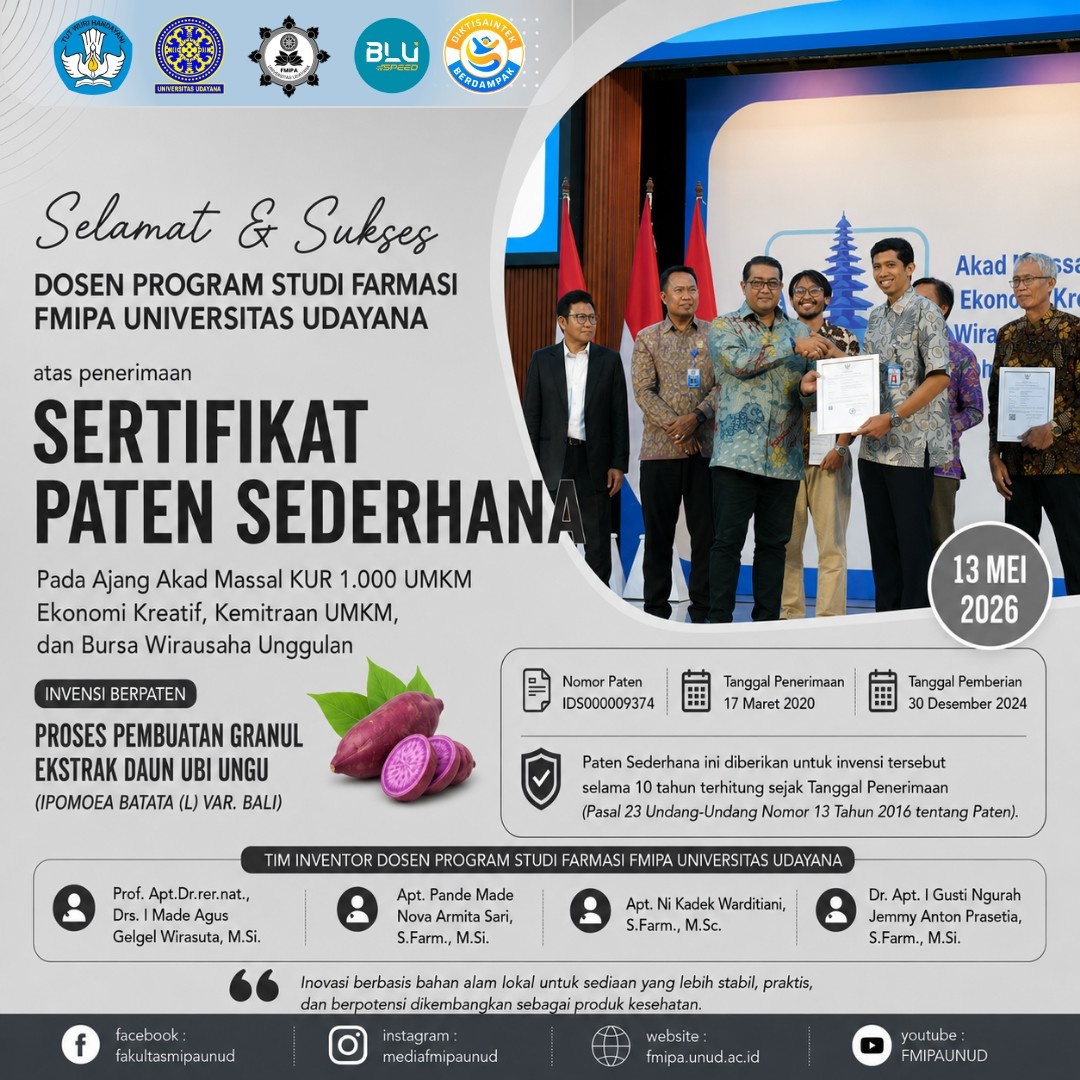
  • FMIPA Udayana University Pharmacy Lecturers Receiv...
    Selasa, 19 Mei 2026
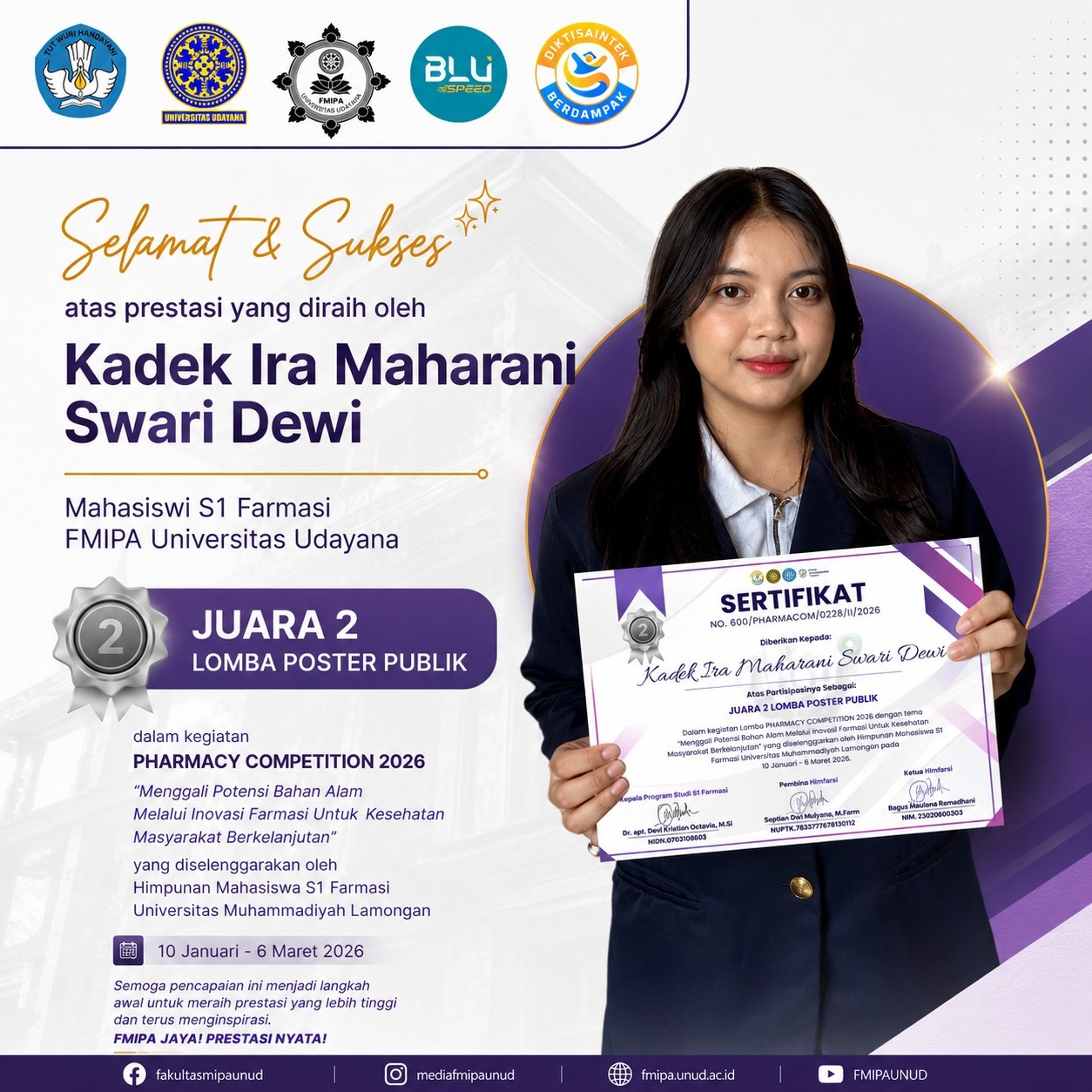
  • Udayana University Pharmacy Student Secures Second...
    Jumat, 25 September 2026
  • iCompEx 2026 Info: An International Innovation Eve...
    Jumat, 8 Mei 2026
See More >>

Announcement

  • Jadwal Ujian Proposal Tugas Akhir (TA 1) Periode 1 Bulan Desember 2023
    Minggu, 10 Desember 2023
  • Jadwal Ujian Proposal Tugas Akhir (TA 1) Periode Bulan Mei 2023
    Senin, 15 Mei 2023
  • Thesis Examination Schedule for April (II) 2023
    Minggu, 23 April 2023
See More >>

Agendas

  • Jadwal Pelaksanaan Ujian Tugas Akhir PS S1 Farmasi Fakultas MIPA Tahun 2023
    Minggu, 8 Januari 2023
  • Online Summer Course 2021
    Senin, 5 Juli 2021
  • Jadwal Pelaksanaan Ujian Proposal Tugas Akhir PS S1 Farmasi Fakultas MIPA Periode Januari Tahun 2020
    Selasa, 21 Januari 2020
See More >>

Contact Us

Program Studi S1 Farmasi

Fakultas Matematika dan Ilmu Pengetahuan Alam

Universitas Udayana

Jl. Kampus Bukit Jimbaran, Badung, Bali, Indonesia

Fax: 

Email: farmasi.udayana@unud.ac.id


Information

  • Universitas Udayana
  • LPDP
  • LPPM Udayana
  • Career Development Center
  • Alumni
  • Science Direct
  • Proquest
  • Elsevier
  • IEEEXplore
  • IEEE Comp Society

Follow Us

© 2021 USDI - Universitas Udayana

  • Campus Map
  • Web Email